Stargazers: Copernicus, Galileo, the Telescope and the Church: Understanding the Heavens 1500-1700
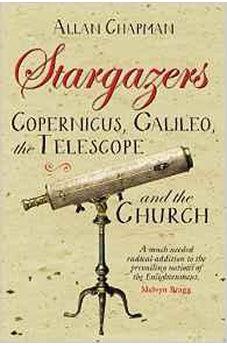
The period from 1500-1700 saw an unprecedented renaissance in astronomy and the understanding of the heavens. In this magnificent tour de force, scientific historian Dr. Allan Chapman guides us through two hundred years of mapping the stars. He shows how Copernicus, Galileo, Tycho Brahe, and Kepler were all part of a huge movement, which included many churchmen, questing for knowledge of the skies. Chapman explores whether Galileo and his ilk were so unusual for their time, bright sparks of knowledge in a sea of ignorance. Or were contemporary Popes, churchmen, and rulers actually fascinated by astronomy, and open to new ideas? Within these pages Copernicus and Galileo find company with Jesuit missionary astronomers in China, Calvinist physicists in Leiden, Bishop John Wilkins's "Flying Chariot" destined for the moon, Johannes Hevelius, Jeremiah Horrocks, Robert Hooke, Sir Isaac Newton, the early Royal Society, and the Reverend James Bradley, who finally detected the earth's motion in space in 1728.
- Paperback : 464 pages
- Item Weight : 1.12 pounds
- Dimensions : 5 x 1.65 x 7.75 inches
Product Information
Product Information
Shipping & Returns
Shipping & Returns
Stargazers: Copernicus, Galileo, the Telescope and the Church: Understanding the Heavens 1500-1700
Stargazers: Copernicus, Galileo, the Telescope and the Church: Understanding the Heavens 1500-1700
The period from 1500-1700 saw an unprecedented renaissance in astronomy and the understanding of the heavens. In this magnificent tour de force, scientific historian Dr. Allan Chapman guides us through two hundred years of mapping the stars. He shows how Copernicus, Galileo, Tycho Brahe, and Kepler were all part of a huge movement, which included many churchmen, questing for knowledge of the skies. Chapman explores whether Galileo and his ilk were so unusual for their time, bright sparks of knowledge in a sea of ignorance. Or were contemporary Popes, churchmen, and rulers actually fascinated by astronomy, and open to new ideas? Within these pages Copernicus and Galileo find company with Jesuit missionary astronomers in China, Calvinist physicists in Leiden, Bishop John Wilkins's "Flying Chariot" destined for the moon, Johannes Hevelius, Jeremiah Horrocks, Robert Hooke, Sir Isaac Newton, the early Royal Society, and the Reverend James Bradley, who finally detected the earth's motion in space in 1728.
- Paperback : 464 pages
- Item Weight : 1.12 pounds
- Dimensions : 5 x 1.65 x 7.75 inches
Product Information
Product Information
Shipping & Returns
Shipping & Returns
Description
The period from 1500-1700 saw an unprecedented renaissance in astronomy and the understanding of the heavens. In this magnificent tour de force, scientific historian Dr. Allan Chapman guides us through two hundred years of mapping the stars. He shows how Copernicus, Galileo, Tycho Brahe, and Kepler were all part of a huge movement, which included many churchmen, questing for knowledge of the skies. Chapman explores whether Galileo and his ilk were so unusual for their time, bright sparks of knowledge in a sea of ignorance. Or were contemporary Popes, churchmen, and rulers actually fascinated by astronomy, and open to new ideas? Within these pages Copernicus and Galileo find company with Jesuit missionary astronomers in China, Calvinist physicists in Leiden, Bishop John Wilkins's "Flying Chariot" destined for the moon, Johannes Hevelius, Jeremiah Horrocks, Robert Hooke, Sir Isaac Newton, the early Royal Society, and the Reverend James Bradley, who finally detected the earth's motion in space in 1728.
- Paperback : 464 pages
- Item Weight : 1.12 pounds
- Dimensions : 5 x 1.65 x 7.75 inches